
Baramundi @ Siakap pertama dgn taknik CASTING

Siakap pertama ku dengan taknik CASTING mengunakan umpan udang hidup

Gelama torak and siakap yang berjaya di tawan di sungai lato kong kong pada 4/7/2012 bersamaan 14 syaaban (air besar tu)
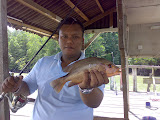


Siakap pertama ku dengan taknik CASTING mengunakan umpan udang hidup
Gelama torak and siakap yang berjaya di tawan di sungai lato kong kong pada 4/7/2012 bersamaan 14 syaaban (air besar tu)

Sotong pancing kat tioman, guna cara yoyo. Ni kara kecik ada yang lagi panjang. Seronok giler dengan pengalaman pertama mencandat sotong dengan yoyo.

1 Accept the fact that something fluttering up and down stimulates the "strike" option in a game fish's brain more than something fluttering through the water parallel with the bottom. The fish thinks both types of erratic movement is that of wounded or crippled bait, but something fluttering up and down is more crippled and the easiest meal.
2
Use a long pole for jigging. If you are in deep water jigging straight up and down, the further you get the lure away from the boat's bottom silhouette, the less wary the fish are. If you are on a stationary pier, it doesn't matter. Make the up and down movement as erratic as possible by using the lightest possible weight, if any, to keep the jig going up and down.
3
Select a jig in the fishing section of your favorite store. If you are fishing on the Gulf Coast, you won't be able to jig straight up and down because the bays and surf are shallow. You want a jig that is weighted so that you can cast it a considerable distance. The jigging then becomes a series of "bounces" off the bottom or before the jig hits the bottom. Jigging off the bottom is a lot less work and will catch more flounders. A jig doesn't need to "flutter" as much as a jerk or swimbait, but it doesn't hurt.
4
Color is more important on a jig than many other types of lures because when it hits bottom the "thud" often attracts a fish. The fish must be able to differentiate the momentarily still lure from its environment. Pick very light colors and stay away from tan or beige.

Baitfish
Color:Chart Pepper Neon (Glow)
Size:4.00 "
Weight:n/a
Amount:7
Model # (Product ID):GSBF4-CPN (1139704)
Replaces live bait for better durability and longer lasting results. Natural presentation in action, scent and taste.

Kickin' Goby
Segmented body with kicking tail
Durable soft plastic body
Life-like swimming action
Single hook on back for snag-free presentation close to the bottom
Holographic insert
Holographic WildEye
Polycarbonate lip

Classic X-Rap finish combined with an easy to produce walk-the-dog cadence makes the X-Rap Walk unbeatable for topwater action – just like the smaller Skitter Walks with the same body shape. 4X VMC Sure Set Black Nickel feather tail hook taunts them, then sticks ‘em good with positive hook sets. Designed primarily for salt species, but larger freshwater species can’t resist.

The X-Rap is "all about the action" and it triggers strikes. It has the three-dimensional shape of a minnow and is available in three sizes. Prominent scales and the lateral line on the fuselage and the internal holographic foil capture and flash light like a beacon. It's a lure that is designed for aggressive fishing. The angler provides the action and defines the cadence, for maximum effectiveness. The X-Rap has an exaggerated body rolling action on a steady retrieve and it can be fished very slowly if needed. Due to its neutral buoyancy, the X-Rap can be let sit suspended in the water for extended periods to drive even inactive fish nuts.
Thanks to its versatility, X-Rap is the only lure you need all season long.
How To Fish
X-Rap (salt water)
To get the most out of the X-Raps slashbait action, use your rod to give the lure more action. The X-Rap responds well to twitches, snaps and jerks – just vary the length and speed of your rod movement to create different actions from sweeps to aggressive darting.
When fish are extremely active, use the hard "snap" retrieve. With your rod tip down, use a short snap, snap, pause retrieve to get the X-Rap to follow a narrow track right. When fish are suspended over deep water or to trigger shallow fish use the "sweep" retrieve. With the rod tip up, use a long sweep, sweep, pause retrieve for a wider track.

Built to handle the tropical brutes on all equatorial waters, the Barra Magnum has passed the test with flying colors around the world. Whether fishing for barramundi in Australia, peacock bass in the Amazon or pike and zander in Europe, the Barra Magnum is up to the task. With all the features of the original Magnums, the Barra Magnum is slightly heavier than the Floating Magnum due to abachi wood construction. Tough, yet incredibly buoyant, abachi imparts a slightly different than its balsa counterparts. Lip design dives the Barra Magnum even deeper than the same size CD Magnums. Specially developed colors along side the tried and true Magnum patterns put you in charge when challenging the demon of the deep.
How to fish
Barra Magnum
The buoyant Barra Magnum is ideal for crankbait presentations and fishing drop-offs up to three meters (10 feet) deep. Just crank the lure down and when you hit the bottom, stop the retrieve and give the lure a little slack and allow it to back out of trouble. The tight action performs equally well with a steady retrieve and a pull and pause presentation.
The Barra Magnum has a natural tendency to veer to the side when it hits an object â you can feel this on the retrieve when the lure misses a beat. Thanks to this feature the Barra Magnum can be fished through sparse submerged vegetation without hang-ups.

Spiderwire® Super Mono® XXX is designed to offer maximum performance in both fresh and saltwater applications. This premium monofilament has all of the things you are looking for in a top quality fishing line rolled into one. It's thinner, stronger, and more sensative than all the others. It has low stretch, low memory, and high abrasion resistance to help you bring your catch out of those nasty places that fish like to hide. With Spiderwire®, Nothing Gets Away!

As with ALL Spiderwire® products, the all ® Ultracast™ 100% Fluorocarbon is the Thinnest, Strongest, Most Sensitive Fluorocarbon ever made. Besides being ultra-clear and invisible, it has exceptionally high strength per diameter compared to all other fluorocarbons. Its thin diameter actually helps baits perfom much better, yet its ultimate sensitivity transmits strikes and structure better than any other fluorocarbon on the market today. With Spiderwire®, Nothing Get's Away!

BLUE WHALE 2 x 250 E.F.I. NEW
The most powerful and technologically advanced engines, paired for incredible performance. Fitted with counter-rotating steel propellers, double-lever remote control unit and 'double' starter panel for comfortable navigation with plug and play LAN digital equipment. They are available exclusively in package formula with the wide range of Selva Marine pneumatic and fibreglass boats.
NEW FOR 2010, 4T EFI V-6 WITH 200, 225 AND 250 HP ENGINES, INDIVIDUAL AND IN A COUNTER-ROTATING PAIR, AVAILABLE EXCLUSIVELY IN PACKAGE FORMULA WITH THE WIDE RANGE OF SELVA MARINE PNEUMATIC AND FIBREGLASS BOATS.
Power Hp 2 X 250 EFI
Power Kw 2 X 183,9
Max. R.P.M. 5000/6000
Motor type 4 strokes DOHC - 24V with VTC direct acting\nSwept volume c.c. 3352 2 x
Swept volume c.c. 2 X 3352
Bore x Stroke (mm) 2 X 94x80,5
N° Cylinders 2 X 6 a V 60°
Induction Electronic injection
Starting Automatic
Oil/fuel mixing Petrol (for specifications see the user manual)
Fuel tank (L) -
Lubrication Forced (oil sump)
Ignition T.C.I./Computer
Ignition timing Electronic
Starting Electric
Alternator Standard 2 X 12V/550W with regulator
Cooling Water cooled with pump-forced circulation
Exhaust Under-water through propeller
Steering system Remote steering system with remote control box
Type of remote control box provided (for the versions with remote control box) Two lever binnacle with safety switch
Trim adjustment Power Trim/Tilt
Direction reversal Mechanical A-F-R
Transmission ratio 13/30
Standard propeller type 3-bladed with built-in spring drive
Weight basic version (Kg) 2 X 278
The data contained in this table are to be considered as approximate and Selva S.p.A. reserves the right to modify the technical characteristics, materials, construction, weights, colors, graphic lines, etc. Without any forewarning or obligations.

* New Concept Fuji Alconite or Fuji Hardloy guides
* Gudebrod thread wrapped guides
* Convenient hook keeper
* Fuji reel seat
* Custom shaped EVA foregrip and reargrip
* Gimbal with removable butt cap on selected models

* Aluminum Lo-Mass Spool System
* Super Stopper
* Assist Stopper
* High Speed 6.5:1 Retrieve
* High Density EVA Power Grips
* 6 Shielded Stainless Steel Ball Bearings
* VBS (Variable Brake System) with Reduced Mass Hub
* Disengaging Levelwind System
* Quickfire II Clutch Bar
* 1/8 Turn Easy Access Attached Sideplate
* Drilled Handle Shank
* Ceramic Line Guide
* Recessed Reel Foot
* Metal Cast Control Knob
* Rated for use with Mono, Fluorocarbon and PowerPro lines
* Approved for use in Saltwater
I just married a few month ago. I'am so lucky because my wife share my no one hobby. Do you know what is our hobby? It fishing ........................ That why I love her so much. But now she can't go fishing with me, because she's pregnant our first son. 
Shimano Curado
Winner of the 2008 ICAST New Product Showcase Awards for Best of Show and Best Freshwater Reel!
The high performance Shimano Curado reel is ultra smooth, makes effortless casts, and is available in a 7.0:1 high speed, 5.0:1 power versions. New 200 size is smaller than the previous Curado 100D but holds the same amount of line as the previous 200DHSV. Compact and lightweight with the heart and power of a large reel. The Curado 300 reel will change the way you think about low-profile baitcasting reels. Now you can expect large reel performace in a sleek, comfortable design that offers all of these benefits:
High Speed and Power
Excellent Casting Performace
Comfort and Maneuverability
High Line Capacity
Ability to Handle Large Plugs and Swimbaits
Product Description:
The new 200's are smaller than 100's with the capacity of a 200. Aluminum Frame, Lightweight Graphite Sideplates (Aluminum Handle Side on 300 sizes), Recessed Reel Foot, High Efficiency Gearing (HEG), Super Free Bearing Supported Pinion Gear System (SF), A7075 Aluminum Magnumlite Spool, Dartainium Drag, 7 Bearings • 1 S A-RB BB • 5 Shielded Stainless Steel BB • 1 A-RB Roller Clutch Bearing, Variable Brake System (VBS) with Reduced Mass Hub, Super Stopper II, Assist Stopper, Drilled Handle Shank, Septon PV Power Grips (SV on 300 sizes), Cold Forged AL Drag Star with Clicking Adjustment, Titanium IP Line Guide, 1/8 Turn Easy Access Attached Sideplate, Metal Cast Control Knob, Double Anodized Spool and Handle, Disengaging Levelwind System, QuickFire II Clutch Bar and Made in Japan.

When a fish feels the hook, it struggles to get free. This might involve jumping, making a long run, swimming back against the line or swimming around obstacles. Each species of fish fights differently.
Fish hooked in shallow water are more likely to jump and behave more frantically than those hooked in deep water. Deep-water fish often seek the bottom.
It's possible to land many small fish just by reeling them in. They'll fight, but they aren't as strong as the line and the rod. Use lighter tackle and you can get some fight out of the smallest fish in the lake.
If you're catch and release fishing, don't fight too long or the fish will die from exhaustion before or after you release it.
Fighting Bigger Fish
Setting the Drag
If a fish makes a run for it, don't panic. And don't try to reel in while the fish is swimming away from your line. Relax and let the drag and rod do the work. After you've set the hook, set your drag. If you're using 12-pound test, you should use about 4 pounds of drag. Just keep the rod at about a 45-degree angle to the water aim it straight at the fish.
When the fish slows down and stops taking more line, it's time to go to work. The best technique for the catch is to gently pull the rod up and then reel down as you lower it, using a pumping motion. Do it in small, smooth strokes rather than large abrupt sweeps because it will help keep both the line tight and the fish much calmer.
If the fish runs again, let it go and you will probably notice that this run is shorter and slower. But don't let the fish rest. If you can't hear your drag working, you should be reeling.
Don't be anxious. Even if you get the fish close to the boat, that doesn't mean it's done fighting. If it turns and runs, let it go. Your line is pretty short at this point, and pump-and-reel action could break it.


